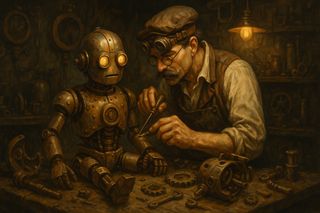
My father was a mathematics professor. He spurred my hunger for understanding from a young age. Classes always bored me and I would lose my focus easily. So, when it came time to do my homework, I was usually lost. He sat with me and taught me, often through several attempts and different methods. I remember the feeling when things finally clicked. I remember going from the kid who didn’t get it to the kid who earns the A. I remember falling in love with proofs in my high school geometry class. I would show off everything I could prove to my dad. Once, I came across some interesting-looking shape (I don’t actually remember. It had to do with angles from triangles inscribed in circles) and had an intuition that some angle had to be a right angle (again, I don’t recall exactly). My dad said “I don’t think you’re far enough along in the semester to prove or disprove that, but sit and think about it and we can talk about it.”
I think that’s the thing: he makes math feel like a puzzle. Like a crossword or a Rubik’s Cube or an Advent of Code challenge. Even as I’m well into my forties, he still makes me feel like a kid and he is some great and all-knowing wizard. He will give me a wry smile as if to say “oh ho! Let’s see if you can solve this one…” I never attained what he has; I made it through calculus II in college, but I never got it the way he does. I once heard someone say “I dream in Spanish” to mean while they could speak Spanish and English equally, their most basic understand was through Spanish. When we talk about programming languages, I like to borrow that idea and say “I dream in Rust.” It’s simple. It’s natural.
I think my dad dreams in Math.
We recently threw a party for my son’s birthday. We had friends and family gathered for a simple backyard hotdog fest (the boy’s idea). As these things tend to go, my wife and I were moving from group to group trying to get face-time with everyone. I’m not sure how, but the conversation moved to technology and how the last 10-20 years have felt like an eruption of technical breakthroughs. I said something about how the last hundred years looks like an exponential curve. I saw that smile creep over his face.
No matter where you are under an exponential curve, it always looks like an exponential curve.
I knew that. Wait, did I just memorize that? Did I understand that? …What does that mean? Okay, no… I knew that. I remembered that if you picked a random point on the x-axis and zoom in, you could rescale the vertical axis, it will look identical to the original. I knew that… I think. But I didn’t understand it. Like, I understood that as a rote fact, but not conceptually or practically; not how it applies to really anything tangibly outside of compounding interest.
And then the moment passed. I had nodded in agreement and we were back at the birthday party and my dad was talking to the other grandparents about music. I went to bed that night thinking on that moment and what was said. And that smile. Every couple of days I would find myself in a quiet moment and reflect on those words and wonder the meaning. If time is our x-axis and we map technology along the y-axis, then it doesn’t click for me. My dad grew up with radio, then television, then eventually computers. I grew up with computers already existing, then the internet, then smartphones, reusable rockets, and AI! All within the last short period. That doesn’t feel like I’m anywhere under the curve; it feels like I’m at the accelerated growth stage where the graph grows to infinity. Did it feel like that to him when his family turned on their first television?
As the days turned to weeks, the itch only got harder to ignore. No longer did the thought intrude only on quiet moments. I would be in meetings — important meetings — and it would flash across my mind, distracting me. And so, I did what I always did: research to try and solve dad’s latest puzzle. Dad’s passion in math is numerical analysis; I remember him trying to get me to understand summations and limits when I was taking calculus and the way that made the most sense to me was taking slivers at discrete steps. “Okay. Every step for x2 doubles: 1, 2, 4, 8, 16… and those represent technological breakthroughs. Oh, but we said the x-axis is time…”
*click*
At every point, the recent past looks relatively slow because it started from a lower base, while the immediate future looks astonishing because the same step produces much larger visible change. The feeling I keep talking about is only experienced in the “now” when that step occurs. I think I understand what Dad meant: every generation near the frontier feels that it has witnessed an unprecedented technological explosion, because exponential or compounding progress always concentrates its most dramatic absolute changes near the present.
I love puzzles.
Thanks Dad.